
Early Life and Beginnings
Josh Heupel was born on March 22, 1978, in Aberdeen, South Dakota. (Wikipedia)
His upbringing had strong football influences: his father, Ken, was a head football coach at a university, and his mother, Cindy, was a high school principal. (Wikipedia)
He played high school football at Central High School in Aberdeen, where early on he became the team’s quarterback. By his senior year he was named South Dakota’s player of the year. (Wikipedia)
Though he drew offers from several colleges (like Houston, Minnesota, Wisconsin, Wyoming), he wasn’t initially the top candidate — which shows how perseverance played a role early in his journey. (Wikipedia)
Heupel began his college football path at Weber State University, red‑shirting in 1996, and playing in 1997. (Wikipedia)
Then he spent 1998 at Snow College (Utah), before finally transferring to University of Oklahoma (OU). It was at Oklahoma where he truly made his name as a quarterback, ultimately becoming one of the most decorated players in the school’s history. (Wikipedia)

College Stardom: Player at Oklahoma
At Oklahoma, Heupel’s performance soared. His two seasons there (1999–2000) were extraordinary. In 2000, he helped lead the Sooners to an undefeated season and a national championship victory in the Orange Bowl. (Wikipedia)
That same season, Heupel received a string of prestigious awards and honours:
-
He was named Consensus All-American. (Wikipedia)
-
He won the Walter Camp Player of the Year Award. (Wikipedia)
-
He was AP College Football Player of the Year. (Wikipedia)
-
He earned the Big 12 Offensive Player of the Year and was First-team All-Big 12 in 2000 (and Second-team All-Big 12 in 1999). (Wikipedia)
Over his short but impactful playing career at Oklahoma, he passed for 7,456 yards and threw 53 touchdowns — placing him among the top quarterbacks in the school’s history in passing yards, completions, and touchdown passes. (Utah State University Athletics)
In 2000, he was also runner-up for the prestigious Heisman Trophy — a testament to how highly he was regarded nationwide. (Wikipedia)
Attempt at NFL — and Transition to Coaching
After his stellar college career, Heupel was drafted in the sixth round of the 2001 NFL Draft by the Miami Dolphins. (Wikipedia)
However, his NFL journey faced setbacks. Shoulder problems hampered his throwing arm, limiting his chances, and he did not make the Dolphins’ active roster. (Wikipedia)
He later signed with the Green Bay Packers in the early 2002 offseason — but was released before the start of training camp. (Wikipedia)
While his NFL dreams didn’t flourish, this turn would ultimately lead him down a different, ultimately more impactful path: coaching.
Coaching Career Begins: Assistant Roles
Heupel began coaching at his alma mater, OU, as a Graduate Assistant in 2004. (Wikipedia)
In 2005, he moved to the University of Arizona as Tight Ends coach. (arizonawildcats.com)
He returned to Oklahoma in 2006 as Quarterbacks coach — a role he held until 2010. His efforts contributed to keeping OU’s offense competitive and modern. (Wikipedia)
In 2011, he was promoted to co‑Offensive Coordinator and quarterbacks coach at OU — a recognition of his offensive acumen. He called plays and helped design a dynamic offense. (Wikipedia)
However, after the 2014 season, in a restructuring of the program, OU did not renew his contract. (Wikipedia)
Re‑building and First Head Coach Role
Undeterred, Heupel accepted a role at Utah State University in 2015 as Assistant Head Coach, Offensive Coordinator, and Quarterbacks coach. (Wikipedia)
After one season there, he moved to the University of Missouri as Offensive Coordinator and quarterbacks coach (2016–2017), continuing to build his coaching résumé. (Wikipedia)
Then, in December 2017, Heupel got his first head‑coaching job: at UCF Knights (University of Central Florida). (Wikipedia)
He inherited a program and swiftly turned it into a high‑powered offense. In his first season (2018), UCF posted an impressive 12–1 record, won the conference championship, and earned a bowl game berth. (University of Tennessee Athletics)
Under Heupel, UCF ranked among the top in the country in scoring offense and total offense every season — showcasing his offensive philosophy and coaching style. (University of Tennessee Athletics)
Over three years at UCF, Heupel compiled a 28–8 record before accepting a new opportunity. (Wikipedia)
The Tennessee Era — Revival of a Legacy Program
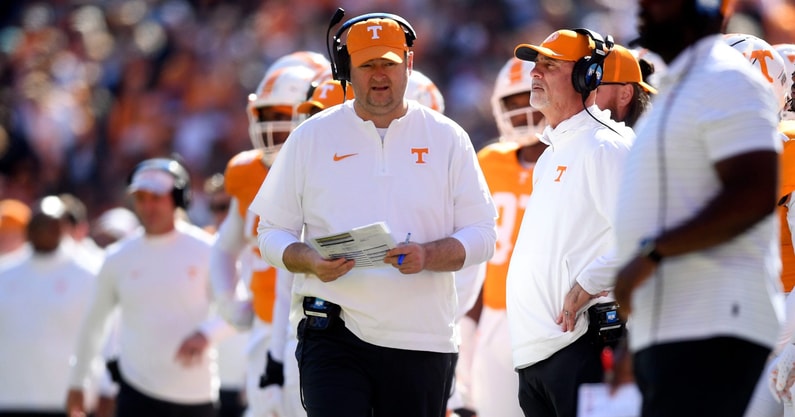
On January 27, 2021, Heupel was named the 27th head football coach of the Tennessee Volunteers. (University of Tennessee Athletics)
At the time, Tennessee was seeking a revival. Before Heupel’s arrival, they had struggled — but his hiring marked the start of a turnaround. (ESPN)
In his first season (2021), the Volunteers went 7–6 overall (4–4 in conference), and earned a bowl appearance. (University of Tennessee Athletics)
The 2022 season was a breakthrough. Tennessee started 8–0 — its best start since 1998 — and overcame a string of losses to rivals. Under Heupel, the offense exploded: the Volunteers led the nation in major offensive categories (scoring offense, total offense, passing efficiency) and set multiple school records (total points, yards per game, touchdowns, passing yards, fewest interceptions, and many others). (University of Tennessee Athletics)
That performance earned Heupel the title of SEC Coach of the Year (2022). (University of Tennessee Athletics)
By 2024, under Heupel’s leadership, Tennessee returned to prominence — marking its first College Football Playoff appearance in decades. (University of Tennessee Athletics)
Reflecting his success and the program’s turnaround, in August 2025, the university extended Heupel’s contract through January 2030. (ESPN)
As of 2025, Heupel has built a 71‑26 overall coaching record (across UCF and Tennessee), ranking among the most successful active head coaches in college football. (University of Tennessee Athletics)
Coaching Style and Philosophy
One of Heupel’s hallmarks is his fast-paced, explosive offense. He tends to emphasize aggressive play‑calling, quick tempo, and strong execution. This approach helped transform both UCF and Tennessee into top‑scoring teams. (University of Tennessee Athletics)
At Tennessee, his ability to instill discipline, build a strong culture, and rejuvenate a lagging program has been widely praised. (University of Tennessee Athletics)
Heupel’s background as a quarterback — having had to battle to find his place early — seems to influence how he develops and motivates his players. That combination of empathy, experience, and strategy has resonated in his coaching journey from assistant roles to leading a top-tier program.
Legacy — From Player to Influential Coach
What makes Josh Heupel stand out is the breadth of his football journey: from a high‑school quarterback in South Dakota to national champion at Oklahoma, from an unsuccessful NFL bid to becoming a transformative college coach.
As a player, he earned virtually every major individual award in college football — showing skill, leadership, and excellence. As a coach, he’s proving equally impactful, helping reshape programs and restoring prestige where there was decline.
His success at Tennessee — reviving a historical program, leading them back into playoff contention, and securing a long‑term coaching contract — suggests his influence will be long lasting.
Many view him now not just as a former star quarterback, but as one of the most promising and effective coaches in college football today.