
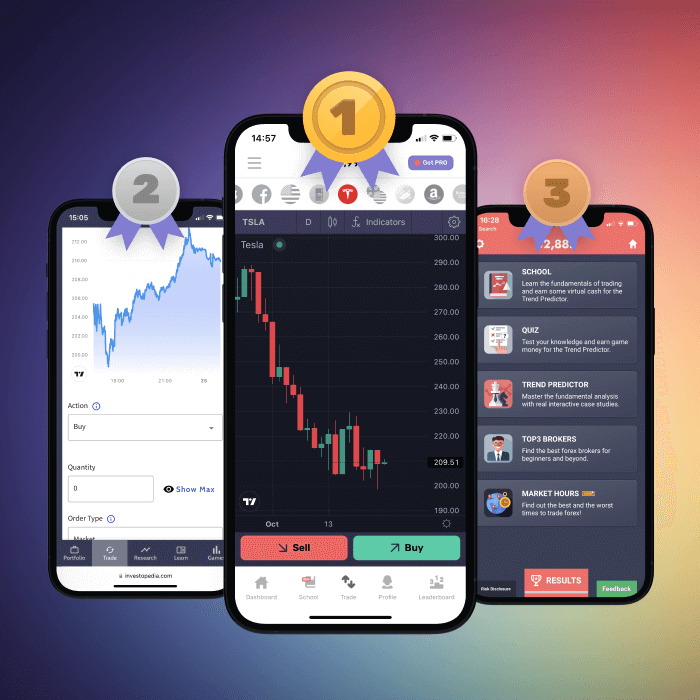
The “Stock Market Simulator Game” is a mobile app (also available as a web‑app) that lets you practice stock/asset trading using virtual money instead of real money. (Google Play)
-
When you start, you typically get a virtual balance (e.g. USD 100,000 or similar) to invest. (Google Play)
-
You can buy and sell different types of assets — stocks, forex (currencies), commodities (gold, oil), indices — depending on what the app offers. (Google Play)
-
The asset‑prices are often updated in real-time (or near real-time), which means you see price moves just like in the real market. (Google Play)
-
Besides the simulator, the app often has a “learning/training” or “trading school” section — where beginners can learn stock market basics, chart reading, risk management, trading strategies etc. (App Store)
In short: it’s a paper‑trading + learning + simulation game. It gives you a “safe sandbox” to experiment with market moves and trading strategies — no actual money involved, no real risk.
Key Features & What You Can Learn
Here are the main functionalities and benefits of using such an app:
✅ Realistic Trading Environment (Without Risk)
-
You get a virtual portfolio — so you can buy/sell assets without risking real money. (Google Play)
-
Real‑time or frequently updated market data — so price changes and volatility are similar to actual stock market behaviour. (Google Play)
-
Variety of assets: stocks, forex, commodities (like gold, oil), indices — gives you a chance to explore different markets. (Google Play)
📘 Learning Tools & Trading Education
-
“Trading School” or tutorial content — interactive lessons about the basics of stock trading, technical analysis, reading charts, managing risk etc. (Stock Market Game)
-
Practice of real trading skills: because you’re not just passively reading — you can act (buy/sell), and see consequences — good for building familiarity with order execution, timing, risk management. (Google Play)
-
Experiment with strategies: day trading, swing trading, commodity/forex trading, portfolio diversification — all possible in a “virtual money environment.” (StockGro)
🏆 Gamified & Engaging Learning
-
Some versions include leaderboards, weekly challenges or fantasy‑style competitions among users — adds fun and motivation. (Google Play)
-
Good for beginners — since there’s no financial risk, it reduces fear, and helps build confidence before entering real markets. (Stock Market Game)
Pros & Cons — What Works, What to Be Careful About
👍 Pros
-
Risk‑free learning: You can experiment freely without worrying about losing actual money.
-
Safe environment for beginners: Helps you understand how markets move, how trades are executed, how charts work — all without pressure.
-
Real‑time data & multiple assets: Simulation closer to reality gives a more meaningful practice.
-
Education + hands‑on at once: You don’t just read about trading — you do it, make mistakes and learn.
-
Flexible and convenient: Use anytime, anywhere — on mobile or web; suitable for people with little or no prior knowledge.
⚠️ Cons / Limitations
-
Success in simulator doesn’t guarantee success in real trading. Simulators can’t replicate the psychological pressures, emotions, sudden liquidity crunch, slippage, execution delays that come in real markets. (Investopedia)
-
Sometimes “virtual profits” can give a false sense of security — you may start thinking “it’s easy”, and real money risk might lead to mistakes. Experts warn about this gap between simulated and real trading. (Investopedia)
-
Over‑simplification: Many real‑world aspects — taxes, brokerage fees, market depth — may be missing, so simulation remains limited. (Techjockey)
-
Some features (advanced charts, real-time data, “pro” content) may be behind paid subscriptions or in‑app purchases. (App Store)
Who is This App Good For — And Who Should Be Cautious
Good For:
-
Beginners who want to learn about stock markets and trading without risk.
-
Students or anyone curious about investing — want to understand how markets move, observe price charts, try buys/sells, without financial commitment.
-
People testing strategies — swing trading, commodity trading, forex — virtually before trying real trading.
-
Those who want to build confidence and understand trading mechanics before starting real investing.
Be Cautious / Realistic If:
-
You think simulator success = guaranteed success in real markets. That’s rarely true.
-
You expect big profits — real trading involves costs, risks, emotions, volatility, market depth — not captured in a game.
-
You don’t treat it as “learning + experimentation,” but as a “get-rich-quick game.” That mindset rarely serves well.
My View: Should You Try “Stock Market Simulator Game”?
Yes — with a clear mindset. If you approach it as a learning tool, a “virtual practice ground,” it’s very useful. It’s like a flight simulator for future pilots — you learn basics and get comfortable without risk.
However — don’t treat it as “easy money” or assume that virtual gains will translate to real profit. Use it to learn, practice, build discipline, understand charts and market behaviour. Once you get comfortable, maybe you can take small real steps — but with caution, knowledge, and realistic expectations.
Conclusion
The “Stock Market Simulator Game” (and similar stock‑simulator apps) are powerful educational tools — especially for beginners. They provide a risk‑free environment to learn stock market mechanics, try trading strategies, and get familiar with charts, assets, timing, and risk management.
But — always remember the key difference: it’s a simulation. Real markets have real money, real emotions, real risks. So treat the app as a training ground, not a shortcut to wealth.