
When you write a blog post, publish a web page or run an online business, people must first discover your content. That “discovery” often starts with a search engine — like Google. If your article doesn’t use the right words (keywords), Google is unlikely to show it to the right audience.
But not all keywords are equal. Some keywords get many searches but also face intense competition — so ranking on page one is hard. Others have fewer searches but low competition and higher chance of conversions (e.g. people buying or signing up). Those selective, “sweet‑spot” keywords are often called profitable keywords.
In this blog, we will explore how to find profitable keywords — ones that balance search volume, competition (difficulty), and intent — so that your SEO efforts pay off in traffic, leads, or revenue.
What Makes a Keyword “Profitable”?
A keyword becomes profitable when it meets a few conditions:
-
Adequate search volume — enough people search for it each month so that if you rank for it, you get meaningful traffic. (SEO Archive)
-
Low or manageable competition / difficulty — so you have a realistic chance to rank without an enormous backlink profile or massive domain authority. (TechToWords)
-
Right user intent — the people searching are more likely to take the action you want (read, click, buy, subscribe, etc.). For instance, “buy X online”, “best X for Y”, “how to use X” are often better than vague keywords. (Medium)
-
Commercial or conversion potential — If advertisers are actively paying for that keyword (high CPC), it’s a signal that the keyword has value in market terms. (Medium)
In short: profitable keywords are not just high‑search words. They are ones where the opportunity (traffic + conversion + rankability) aligns well with your resources and goals.
Step-by-Step Process to Discover Profitable Keywords
Here is a straightforward method you can follow to find profitable keywords — no matter what niche you are in.
1. Start with a “Seed Keyword”
Think about the main subject / topic of your blog or business. For example: if you have a cooking blog, seeds might be “healthy recipes”, “veg recipes”, “Indian breakfast ideas”, etc. If you provide a service (say – website development), seed could be “website development services”, “WordPress website”, etc.
Once you have a seed keyword, you’ll use it as the base to generate more keyword ideas using tools — but don’t stop at the seed.
2. Use Keyword Research Tools for Suggestions & Data
Tools make the job easier. Many free or paid tools can help you with keyword ideas, search volume, competition/difficulty and more. Some commonly used ones: (Osumare Ahmedabad)
-
Free or freemium tools like Google Keyword Planner, Ubersuggest give basic data like search volume, trends and competition. (Osumare Ahmedabad)
-
Advanced or paid tools like SEMrush or Ahrefs provide deeper metrics — keyword difficulty (KD), CPC, competitor analysis, keyword variations etc. (eflot.com)
Using such tools helps you move beyond guesswork. They show real data so you can base decisions on facts.
3. Look for Long-Tail Keywords
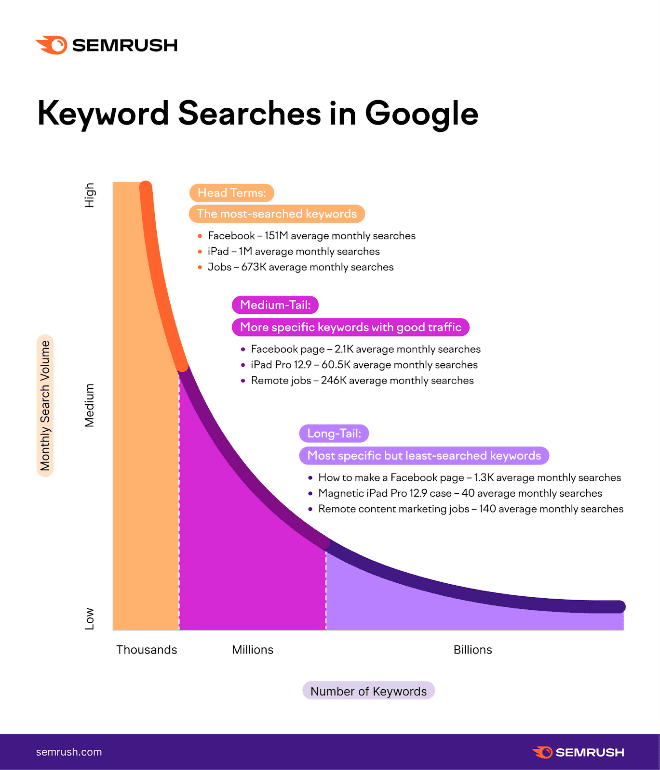
Long‑tail keywords are longer, more specific phrases (often 3+ words). For example: Instead of “shoes” you might target “best running shoes for flat feet” or “lightweight running shoes under $100”.
Why long‑tail? Because they often have lower competition and higher conversion potential (users know what they want). (All About AI)
Despite lower search volume, long‑tail keywords capture targeted and serious users (those with clear needs or questions).
4. Filter by Keyword Difficulty (KD) and Search Volume
When you run your list through a tool like SEMrush or Ahrefs, you get metrics like difficulty (or “competition”) and volume. A common strategy:
-
Set an upper limit for difficulty (for example, KD under 30, or another threshold depending on your website authority). (SEO Archive)
-
Set a lower limit for search volume (for example at least 100 searches/month). (TechToWords)
This gives you a shortlist of keywords that are “low difficulty + enough volume” — often the most realistic to rank for and profit from.
5. Analyze Search Intent
Not all searches are the same. Some people search just to learn (“how to cook dal”), some to compare (“best dal recipe vs another”), some to buy or take action (“buy cooking pot online”).
Understanding why people search (their intent) is vital. Profitable keywords often come from informational (if you provide guides), or commercial/buying intent (if you sell products/services). (All About AI)
So peek at the search engine results page (SERP) for your keyword. What kinds of pages are ranking? If top results are product pages or “buy” oriented, it's a sign of high commercial intent. If top results are purely informational blogs, you might need to match that intent. (TechToWords)
6. Analyze Competitors & Their Weak Spots
See who’s already ranking for your target keywords. Use tools to check competitor domains — what keywords they target, how strong their backlinks are, how well their content is optimized. (LowFruits)
If top-ranking pages have low authority, thin content, or weak SEO — that’s a chance for you. Choose such “weak‑spot” opportunities where you can outrank them with better, richer content. (LowFruits)
7. Cluster Related Keywords (Topic-Based Structuring)
Once you have a list — don’t treat each keyword as separate. Group or “cluster” them by topic or intent. For example, for a blog on “healthy breakfast recipes”, cluster “easy healthy breakfast”, “healthy Indian breakfast ideas”, “high protein breakfast vegetarian” etc.
This helps in planning content that covers multiple, related keywords in one post or series — boosting relevance and SEO. This approach is known as keyword clustering. (Wikipedia)
8. Validate with Real-World Signals & Trends
Sometimes data from tools isn’t enough. You can check:
-
What forums, Q&A sites (like specialized forums, community groups) people talk about — the exact words they use. This shows real user language and search patterns. (TechToWords)
-
Seasonal or trending changes — some keywords get interest only at certain times (festivals, events, seasons). Use trend‑tracking to catch these. (All About AI)
By combining tool data with human signals, you get a better picture of actual potential.
9. Prioritize & Execute — Write Content / Build Pages
From your final keyword shortlist and clusters, decide: which keywords to target first? Which ones have highest potential (volume + low difficulty + good intent)?
Then create content/pages around them — blog posts, product pages, service pages, whichever fits. Make sure content is high quality, answers user intent, and is optimized (title, headings, meta, on‑page SEO etc.).
Common Mistakes When Finding Keywords (and How to Avoid Them)
When doing keyword research — many beginners (and even advanced) make mistakes. Here are common pitfalls and how to avoid them:
-
Chasing only high-volume keywords — ignoring difficulty: You may target a keyword with 50,000 monthly searches but delay ranking because competition is too strong. Best to balance volume with rankability.
-
Ignoring search intent — e.g. you write a review post when users want to buy, or an informational post when they want quick answers. Always match content type with intent.
-
Using only one tool — data can vary across tools; better to cross‑verify using more than one tool (free + paid) or data sources. (All About AI)
-
Picking unrelated keywords just because they look good on paper — but they don’t align with your niche or what you offer. Always check relevance.
-
Not doing competitor research — ignoring what other websites are ranking for your target keywords, missing gaps or opportunities.
-
Not updating over time — search behavior and competition change. What was profitable in past may become crowded. Always review and refresh your keyword strategy.
Some Real-Life Examples & How This Works in Practice
Suppose you run a small blog about “budget travel in India”.
-
Seed keyword: “budget travel India”
-
Long‑tail variations might be: “budget travel India 2025 tips”, “cheap travel itineraries India for students”, “backpacking India low budget guide”.
With a tool like SEMrush or Ubersuggest you check these — filter for low difficulty + decent volume. Maybe “backpacking India low budget guide” has manageable difficulty, and monthly search volume of 200–300. Good candidate.
Next — check top search results: maybe top 10 are outdated blog posts or weak sites. That’s your chance: write a fresh, detailed, updated guide for 2025. Use related long‑tail sub‑keywords inside (cluster approach).
Over time — track via analytics & search console: if traffic increases and bounce rate is low, your “profitable” keyword strategy is working.
Another example: Suppose you run a small online store selling “wooden furniture”.
-
Seed keyword: “wooden tables”
-
Long‑tail idea: “handmade wooden dining table India”, “solid wood coffee table under 10000 rupees”, “oak wood study table minimalist design”.
Check difficulty & CPC — if competition is manageable and CPC (advertiser demand) is good — that indicates buyers are looking for such items (commercial intent). Good to build product pages or blog posts around.
Thus, by aligning long‑tail specificity, search intent, market demand — you can get both traffic and conversions.
Why This Approach Works (and Is Recommended)
-
It reduces risk and wasted effort — instead of going after highly competitive keywords and failing, you pick realistic targets.
-
You get better conversion potential — long‑tail and intent‑driven keywords attract users who know what they want (higher chances they convert).
-
It’s scalable and adaptable — you can gradually build clusters of content around a niche, and adapt when search trends shift.
-
It helps smaller websites or beginners compete — even without strong domain authority, you can win with smart keyword strategy and quality content.
In short: this method gives you a data‑driven foundation + human sense of what users want + flexibility, which is often more sustainable long-term than chasing big, high‑volume coins.
Concluding Thoughts
Finding profitable keywords is more than just guesswork — it’s a strategy. By combining data (search volume, difficulty, CPC), understanding of user intent, and smart content planning, you can build a blog or website that attracts relevant traffic and drives results (leads, sales, authority).
Always remember: quality matters. Even the best keyword won’t help if your content doesn’t meet the user’s need. So use the keyword as a guide — but write for humans, not just search engines.
And finally — keep experimenting. SEO and user behaviour evolve. What works today may need tweaks tomorrow. Make keyword research an ongoing part of your content / SEO plan.